
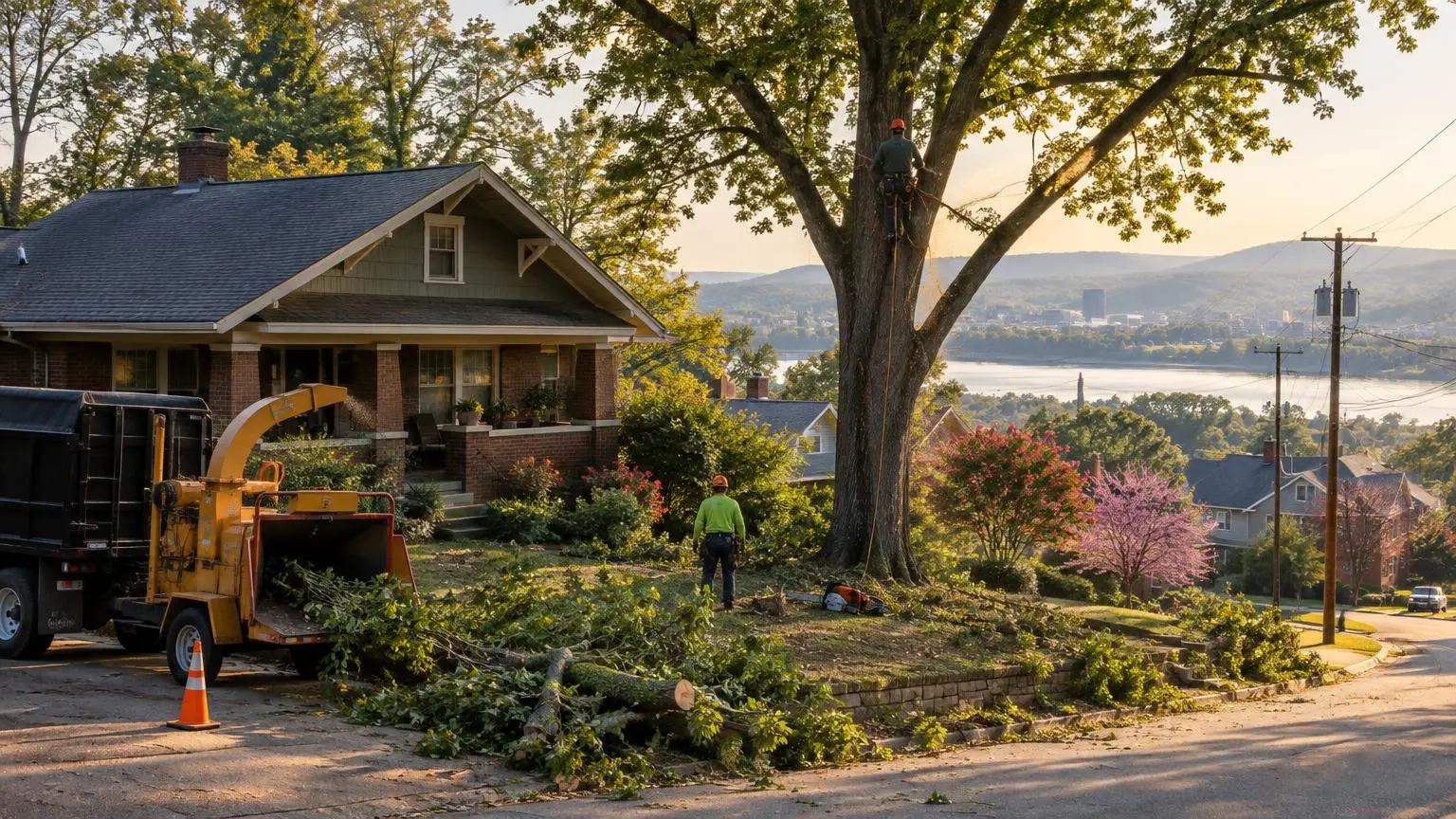
Tree work across Little Rock and Pulaski County
Tree Service in Little Rock, AR
Removal, pruning, stump grinding and storm work for tall pines, old oaks and hillside lots, priced in writing before anything is cut.
- Free on-site estimates across Little Rock and central Arkansas
- A clear written price, no lump-sum guessing
- Yard left raked and cleared as agreed
Ice, Tornadoes, Tall Pines and Old Oaks
Tree service in Little Rock means planning for weather that comes from every direction. Ice storms, spring tornadoes, summer drought and the occasional heavy wet snow all leave their mark on the same yards. Add tall loblolly pines planted close to houses, century-old oaks in Hillcrest and the Heights, and steep wooded lots in west Little Rock, and most jobs come down to three questions: is the tree sound, what can it hit, and how do we get it cut back or brought down safely with the room available?
Ice and heavy snow
The National Weather Service office in Little Rock calls the December 2000 ice storms the worst icing in almost 70 years. By the evening of December 25, 2000, a massive ice storm was under way in the city, trees and power lines were coated, limbs fell onto houses, and more than 500,000 customers lost power, some for weeks. Twelve years later, the Christmas 2012 storm dropped 10.3 inches of snow on Little Rock and knocked out power to more than 200,000 customers across Arkansas. Ice and wet snow find the same weak points every time: long, heavy limbs over roofs, tight V-shaped forks, and trees with old decay. Thinning and shortening those limbs before winter is cheaper than cleaning up after they fail.
Tornado and wind damage
On March 31, 2023, an EF3 tornado crossed west and central Little Rock on a path of about 34 miles, through Chenal Valley, Breckenridge and Walnut Valley and on into North Little Rock, Sherwood and Jacksonville. More than 2,600 structures were damaged in Little Rock alone, and the city's cleanup collected about 130,000 cubic yards of trees, limbs and other organic debris. Many yards that came through still have trees with cracked tops, hangers caught in the crown, or roots that were loosened when the ground was soaked. Those trees do not always look bad from the street, which is why a close look matters.
Pines, oaks and the pests that follow drought
Loblolly pine is everywhere here, and it grows tall and fast. Arkansas forestry officials note that pine bark beetles go after trees stressed by drought, lightning or damage, with Ips engravers usually hitting one tree or a few at a time; signs include white pitch tubes on the bark, fine boring dust at the base and needles fading from yellow to red. Oaks have their own problem. The University of Arkansas extension service calls hypoxylon canker a common disease of oaks in Arkansas that takes hold in trees weakened by drought, construction injury or other stress, and it has no cure. Emerald ash borer is in the state as well: the Arkansas Plant Board added Pulaski County to its quarantine area in 2014, and federal forest health surveys counted the beetle in 44 of Arkansas's 75 counties in 2025.
City trees and permits
Little Rock's landscape and tree protection chapter makes it unlawful to remove a tree from a public right-of-way or other city-owned property without a permit, and the Public Works FAQ directs those requests to Parks and Recreation. The same FAQ says a permit is required for clearing land or cutting down more than seven trees in one year. On a typical home lot, removing a tree or two on your own property does not fall under the development rules, since the chapter exempts single-family and two-family zoned lots of two acres or less. For trees along the street, the code also asks owners to keep 14 feet of clearance over the roadway and 8 feet over sidewalks, and it prohibits topping those trees.
What an estimate covers
- A look at each tree: species, lean, dead wood, cracks, cankers and beetle signs
- What sits underneath: roof, carport, fence, pool, driveway, the neighbor's yard
- The service line from the pole and whether Entergy needs to disconnect it first
- Access: gates, slopes, retaining walls and how a chipper or lift can get in
- What happens to the logs, brush, chips and stump
- A written price per tree, with nothing added unless you approve it
Why Homeowners Call Little Rock Tree Service Pros
Priced at the tree, in writing
Each tree gets its own line: the work, the cleanup, the stump and the price. You approve it before anyone starts a saw.
Weather-wise pruning
We look for the long limbs, weak forks and old wounds that fail under ice and wind, and tell you which ones are worth cutting back now.
Right-of-way and power lines sorted out first
If a tree looks like a city tree, or the service line needs to be disconnected, we say so up front so the job is not stopped halfway.
Pine debris handled with care
Wood from beetle-hit pines is hauled off or moved away from healthy pines instead of being left stacked beside them.
Common Questions
How much does tree service cost in Little Rock?
It depends on the tree's height, its condition, what it is near and how easy it is to reach. National 2026 guides from HomeGuide put most removals between about $200 and $2,000, with very large trees higher, and Homeyou's 2026 Little Rock figures put trimming a medium tree at about $365 to $543. Stump grinding usually runs about $100 to $400 per stump. We give a written price after seeing the tree, and that price is what you pay.
Do I need a permit to cut down a tree in Little Rock?
For a tree on your own home lot, usually not. Little Rock's landscape chapter exempts single-family and two-family zoned lots of two acres or less, but the Public Works FAQ says a permit is required for clearing land or cutting more than seven trees in one year. Any tree in the public right-of-way or on city property needs a permit from Parks and Recreation before it is removed. If you are in an HOA or a historic district, check those rules too.
Will Entergy trim or remove a tree near my power line?
Entergy Arkansas maintains trees along its primary lines from pole to pole. The service line from the pole to your house is the customer's responsibility, so trimming around it is a job for a tree company, and Entergy says it can temporarily disconnect service at no charge so the work can be done safely. Entergy also does not pick up debris from storm damage or customer-requested trims. For a tree on a primary line, call 800-368-3749.
Is there a tree service near me that can come out after a storm?
If you are in Little Rock or the nearby towns, call (501) 457-9035 and leave the details any time. Storm calls are sorted by danger, so a tree on a roof, a blocked exit or a limb hanging over a walkway gets looked at before a tree lying across the back lawn. If a tree is touching a power line, stay away from it and call Entergy first.
When should trees be trimmed in central Arkansas?
Many shade trees are easiest to prune in late winter while they are dormant, when the branch structure is easy to see and before spring growth starts. The University of Arkansas extension service says spring-flowering plants such as redbuds and dogwoods should be pruned right after they bloom. Dead, cracked or storm-damaged limbs should come off whenever you find them, without waiting for a season.
What will the city pick up if I keep the brush?
Little Rock collects yard waste weekly, on the business day after your garbage day. Limbs should be under six feet long and no more than six inches in diameter, stacked within five feet of the curb, and leaves and twigs go in bags, boxes or cans under 30 gallons and 50 pounds. Bigger wood from a removal is usually hauled off by the tree company or cut to firewood length for you to keep.
Should I remove a pine that is turning brown?
Act quickly if it is. Arkansas forestry guidance says pine bark beetles favor stressed trees and that infested trees with green, yellow or red needles should come out, while cut pine should not be left next to healthy pines where beetles can move into them. Not every brown pine has beetles, since needle blights and drought also discolor pines, so it is worth having the tree checked before deciding.
Does homeowners insurance pay for tree removal after a storm?
Often it does when a tree falls on the house, a garage or a fence, but rules differ from policy to policy, and a tree that falls in the yard without hitting anything may not be covered. Take photos before anything is moved and call your insurer early. We can give you a written, itemized estimate to send with the claim.
Tree Services in Little Rock
Six services handle nearly everything a Little Rock yard needs, from one dead pine to a storm-wrecked oak over the roof.
Tree Removal
Dead, leaning, storm-cracked and unwanted trees brought down in sections, with the wood handled however you choose.
Learn more →Tree Trimming & Pruning
Deadwood removal, thinning, clearance and storm-prep cuts made to ANSI A300 standards, with no topping.
Learn more →Stump Grinding
Stumps ground below grade with underground lines marked first, and the chips left or hauled off.
Learn more →Emergency Storm Tree Service
Trees on roofs, cars and driveways cleared after ice, wind and tornadoes, in order of danger.
Learn more →Pine Tree Removal
Tall loblolly pines near houses, beetle-hit pines and storm-snapped pines taken down safely.
Learn more →Tree Health & Hazard Assessments
A close look at oaks, pines and storm-damaged trees to decide what to keep, prune, brace or remove.
Learn more →
Towns We Cover
Little Rock is the center of our area, from the river neighborhoods downtown and the Quapaw Quarter to Hillcrest, the Heights, Pulaski Heights, Chenal, west Little Rock and the southwest side toward Otter Creek. Across the river we work in North Little Rock, Sherwood, Maumelle and Jacksonville. To the southwest we cover Bryant, Benton and Alexander in Saline County, and to the north and east, Conway, Cabot and the smaller towns in between. Each place has its own mix: pines and steep ground in the west and in Saline County, older oaks and narrow lots in the historic neighborhoods, newer subdivisions with young trees and HOA rules in places like Chenal and Maumelle. Who owns the street trees and how brush gets picked up also differs from town to town, so check each area page for what we know about your city.
- Tree Service in Little Rock, AR
- Tree Service in Pulaski Heights, AR
- Tree Service in Cammack Village, AR
- Tree Service in North Little Rock, AR
- Tree Service in Sherwood, AR
- Tree Service in Jacksonville, AR
- Tree Service in Maumelle, AR
- Tree Service in Roland, AR
- Tree Service in Scott, AR
- Tree Service in Cabot, AR
- Tree Service in Austin, AR
- Tree Service in Ward, AR
- Tree Service in Lonoke, AR
- Tree Service in Benton, AR
- Tree Service in Bryant, AR
- Tree Service in Alexander, AR
- Tree Service in Shannon Hills, AR
- Tree Service in Bauxite, AR
- Tree Service in Conway, AR
- Tree Service in Mayflower, AR
- Tree Service in Vilonia, AR
Start With a Free Estimate
Free on-site estimates in Little Rock and across central Arkansas.